

Ancient Medicine, Fragrance, and Chemistry Converge in New Study from Pergamon
- Editor
- 2 Şub
- 3 dakikada okunur
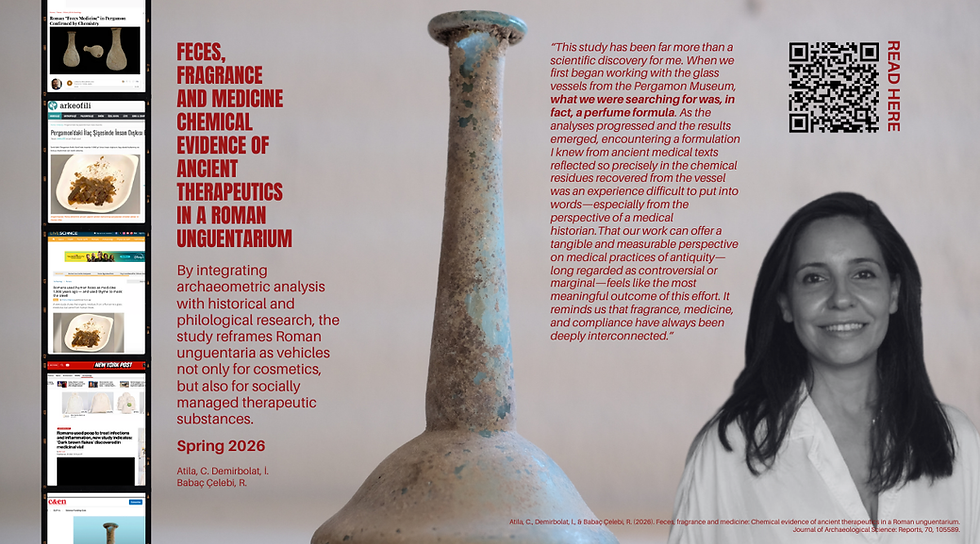
A newly published interdisciplinary study offers the first direct chemical evidence that formulations described in Greco-Roman medical texts—including treatments combining human-derived substances with aromatic ingredients—were not merely theoretical, but actively prepared and stored in Roman vessels.
Published in Journal of Archaeological Science: Reports (Volume 70, April 2026, Article 105589), the research analyzes organic residues recovered from a Roman glass unguentarium (artifact no. 4027) excavated in Pergamon, one of antiquity’s most important centers of medicine and pharmacological knowledge.
Using GC–MS/FID analysis, the team identified human-specific fecal biomarkers (coprostanol and 24-ethylcoprostanol) alongside aromatic compounds, most notably carvacrol, a key constituent of thyme oil. This combination closely mirrors ancient medical prescriptions in which therapeutically active yet malodorous substances were deliberately blended with botanicals to improve acceptability.
Long understood primarily as containers for cosmetics or perfumes, Roman unguentaria are here reinterpreted as vehicles for socially mediated therapeutic preparations, blurring the boundaries between medicine, fragrance, and patient experience.
From Perfumery to Pharmacology
For Dr. Rana Babaç Çelebi, medical historian and clinical aromatherapist, the project began with a different question—one rooted in her broader research into the history of perfume and therapeutic scent. “This study has been far more than a scientific discovery for me,” says Dr. Babaç Çelebi.
“When we first began working with the glass vessels from the Pergamon Museum, what we were searching for was, in fact, a perfume formula. As the analyses progressed and the results emerged, encountering a formulation I knew from ancient medical texts reflected so precisely in the chemical residues recovered from the vessel was an experience difficult to put into words—especially from the perspective of a medical historian.”
She adds that the findings resonate strongly with her ongoing work on the therapeutic, cultural, and sensorial roles of scent across antiquity:
“That our work can offer a tangible and measurable perspective on medical practices of antiquity—long regarded as controversial or marginal—feels like the most meaningful outcome of this effort. It reminds us that fragrance, medicine, and compliance have always been deeply interconnected.”
Relevance for Today’s Fragrance and Flavor Industry
Beyond its archaeological significance, the study speaks directly to contemporary interests in functional fragrance, sensory modulation, and microbiome-related therapies, offering historical depth to current discussions on how scent mediates acceptance, efficacy, and experience.
The research underscores how aromatic ingredients were strategically employed not only for pleasure, but as integral components of therapeutic formulations—a concept increasingly relevant to modern perfumery and flavor design that intersects with wellness, health, and embodied experience.
Collaborative Research
The study was made possible through the identification of the vessel by Archeologist Prof. Dr. Cenker Atila and the rigorous laboratory work led by Dr. İlker Demirbolat, whose analytical precision established the scientific foundation of the project. Together, the team demonstrates the potential of integrating archaeology, chemistry, medical history, and olfactory studies into a single investigative framework.
Publication Details
Atila, C., Demirbolat, İ., & Babaç Çelebi, R. (2026).
Feces, fragrance and medicine: Chemical evidence of ancient therapeutics in a Roman unguentarium.
Journal of Archaeological Science: Reports, 70, 105589.
Project visuals are available here: Bergama Visuals.
About the Author
Dr. Rana Babaç Çelebi is a medical historian, clinical aromatherapist, and researcher specializing in the history of perfume, therapeutic scent, and material culture from antiquity to the modern era. Her work bridges historical sources with scientific analysis, focusing on how fragrance has shaped medicine, ritual, and human experience across cultures.


Yorumlar